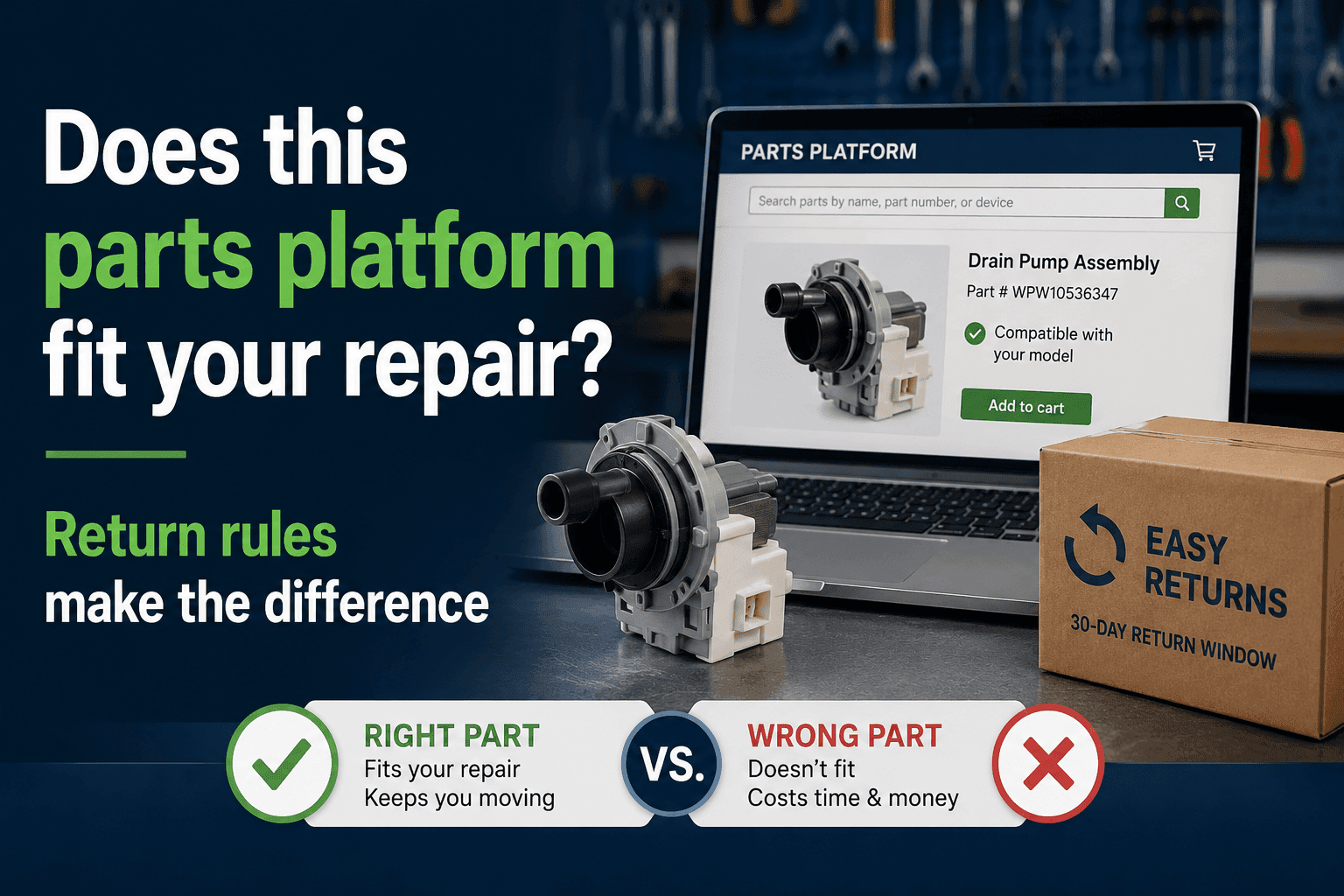
You want to order the right part in one go, so you only have to open your device once. Fixpart.co.uk mainly helps because you can aim your search straight at parts that match your specific appliance, instead of guessing between lookalikes. That matters, because parts often come in multiple versions that look almost identical, but are just slightly different. And since a part can quickly pick up marks from test-fitting or installing, you want to be as sure as possible about your choice upfront.
Start with certainty: model number first, then the part
Start with the model number/model code. That usually narrows results down much better than searching only by brand and appliance name. The system can then filter more precisely within a single model range, where variants may differ in connector type, dimensions, or mounting—even if they look the same at first glance.
That model number is often on a sticker or metal plate, for example on the back, along an edge, behind a small flap, or in the door opening. Once you have that number, it becomes much easier to land on parts that make sense for that exact model.
Why this helps: online, accessories and repair parts are sometimes mixed together. With a model number, you get into the right category faster and spend less time second-guessing between near-identical options.
Practical tip: take a photo of the rating plate and a photo of the broken part. That way you can compare details later without opening the appliance again.
Does the part really fit—and will it actually fix the fault?
The platform mainly helps you find a strong candidate part that matches your appliance. That saves time searching, but one question still matters: does it not only fit, but does it also make sense for the symptom? One symptom can have multiple causes.
What to check to confirm the match faster:
- Size: length/diameter, and for mounting points the distance between screw holes.
- Connector: number of pins and the shape/locking style of the connector.
- Shape details: cut-outs, lips/edges, tabs, and the position of mounting points.
- Wear pattern: seals and hoses that are brittle, cracked, or sticky are often clearly “done” and usually straightforward to replace.
- Signs to double-check first: scraping or rattling (can indicate play/looseness), and discoloration or a sharp smell around electronics (then it’s often smarter to diagnose more carefully first or have someone take a look).
Return rules: where parts get tricky
Returns are more sensitive with parts, because you can create signs of use quickly—even if you only test-fit. Think of a gasket that compresses, an edge that gets nicked, or a connector with visible marks because you had to push it in firmly. The better you match upfront, the smaller the chance you end up in that “test-fit = marks” situation.
What helps keep the return process smooth: keep everything tidy (bags, labels, packing material) and do a test-fit without force. If something doesn’t click, slide, or line up smoothly, that’s often a sign you don’t have the right variant. In that case, re-checking dimensions, tabs, plug type, and screw holes is usually faster than forcing it. Also lay parts and screws out in a logical order; it makes reassembly clearer and reduces the risk of extra damage.
When it’s better to pause (and what alternative makes more sense)
Sometimes ordering isn’t the best first step. Gathering a bit more certainty is often faster—especially if a fault comes and goes, if you have multiple symptoms at once, or if there’s a lot of play and noise. It helps to keep your options tight: with a clear model number and a solid match on size/connector, you avoid ordering “by gut feel.”
Concretely: if you have the model number nailed down and you can link the defect to one specific part (with matching size and connector), you’ll usually land on the right variants quickly. If you don’t have the model number or you can’t pinpoint the cause well, a repair technician—or diagnosing first—often makes more sense than ordering. That helps you avoid ordering the wrong thing and dealing with return hassle.