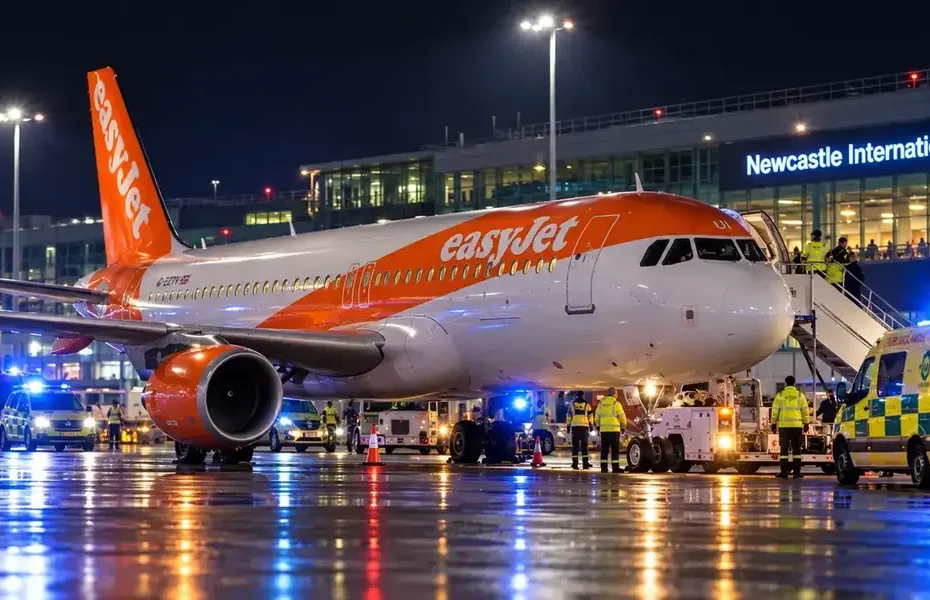
EasyJet flight U2238 made an emergency landing at Newcastle Airport on 27 October 2025 after a passenger on board needed urgent medical attention. The flight was travelling from Copenhagen to Manchester when the crew declared a general emergency and diverted to Newcastle. The aircraft landed safely at 10:52 PM local time, and the passenger was transferred to the Royal Victoria Infirmary for treatment. The flight then resumed its journey to Manchester after a short stop.
This event sits at the intersection of two critical aviation realities: in-flight medical emergencies and the rapid decision-making required to divert an aircraft carrying nearly 200 people. Understanding what happened on EasyJet flight U2238, and why it matters, helps passengers and aviation observers grasp how modern airlines handle crises in the air.
Why Did EasyJet Flight U2238 Divert to Newcastle?
The diversion was triggered by a medical emergency involving a passenger. According to easyJet’s official statement, “Flight EZY2238 from Copenhagen to Manchester on 27 October diverted to Newcastle, due to a customer onboard requiring urgent medical attention”.
The flight crew squawked transponder code 7700 while over the North Sea, signalling a general emergency to air traffic control. Code 7700 is the internationally recognised transponder setting that alerts controllers to an urgent situation and prioritises the aircraft for immediate handling. Newcastle Airport was the nearest suitable diversion point given the aircraft’s position approaching the English East Coast.
The emergency was specifically a passenger welfare issue, not a technical failure of the aircraft. This distinction matters because it shaped the entire response: the crew needed to land quickly, but the aircraft itself was fully operational. After the passenger was handed over to medical services, the flight continued to Manchester without further incident.
EasyJet Flight U2238 Emergency Landing: Key Details
| Detail | Information |
| Flight Number | U2238 / EZY2238 |
| Route | Copenhagen Airport (CPH) to Manchester Airport (MAN) |
| Date | 27 October 2025 |
| Aircraft Type | Airbus A320-200 |
| Registration | G-EZPB |
| Emergency Squawk | 7700 |
| Diversion Airport | Newcastle Airport (NCL) |
| Landing Time | 22:52 local time |
| Passenger Disposition | Taken to Royal Victoria Infirmary (RVI) |
| Flight Resumed | 00:02 on 28 October 2025 |
| Final Arrival in Manchester | 00:29 on 28 October 2025 |
The aircraft, an Airbus A320-200 registered as G-EZPB, was a 9.7-year-old narrow-body jet that had been in service with easyJet since February 2016. It departed Copenhagen at 10:23 PM local time and climbed to flight level FL380 before the emergency was declared.
The landing at Newcastle was swift and controlled. Emergency medical crews from the North East Ambulance Service were waiting on the tarmac. A spokesperson confirmed: “We received a call at 10.33pm on Monday 27 October 2025 to reports of a person unwell at Newcastle Airport. We dispatched an ambulance crew to the scene and transported one patient to the Royal Victoria Infirmary (RVI) for further treatment”.
What Is the Emergency Transponder Code 7700?
When a pilot enters 7700 into the aircraft’s transponder, it broadcasts an emergency signal to every radar screen in the vicinity. Air traffic controllers immediately know the aircraft requires priority handling. The code overrides standard display filters and highlights the flight as an emergency on controller screens.
The three critical transponder codes are:
- 7500 – Unlawful interference (hijacking)
- 7600 – Radio failure
- 7700 – General emergency
On EasyJet flight U2238, the crew’s decision to squawk 7700 was the standard and correct response to a serious in-flight medical situation. It triggered a coordinated response involving air traffic control, Newcastle Airport ground operations, and local emergency medical services.
How Common Are In-Flight Medical Emergencies?
In-flight medical emergencies are more common than many passengers realise. With millions of people flying daily worldwide, health crises at altitude occur regularly.Although the aviation sector has created strong procedures to deal with these situations, each diversion is a difficult, urgent task.
Medical emergencies account for a meaningful share of aircraft diversions. The key challenge is that cabin crew are trained in first aid and can consult ground-based medical professionals via satellite link, but definitive care requires landing. When a passenger’s condition is serious enough, the captain must weigh the urgency of the medical situation against the nearest suitable airport, weather, and aircraft performance.
Newcastle Airport handled the EasyJet flight U2238 emergency landing with precision. The airport’s emergency plan was activated quickly, and the passenger was in hospital shortly after landing. The aircraft was refuelled and airborne again within approximately 70 minutes.
What Happens During an Aircraft Medical Diversion?
When a medical emergency occurs on a commercial flight, the response follows a clear chain of decisions:
- Cabin crew assess the passenger. Flight attendants are trained in basic life support and use onboard medical kits, including automated external defibrillators and oxygen.
- The captain is informed. The pilot evaluates the situation and may consult with a ground-based medical advisory service.
- A diversion decision is made. If the passenger’s condition requires urgent hospital care, the captain selects the nearest suitable airport.
- ATC is notified. The crew declares an emergency, often squawking 7700, and requests priority handling.
- Ground services mobilise. The airport alerts medical crews, who meet the aircraft on arrival.
- The passenger is transferred. After landing, the patient is handed over to paramedics.
- The flight continues if possible. Once the situation is resolved, the aircraft can resume its journey, as happened with EasyJet flight U2238.
This sequence reflects a system designed to put the passenger’s health first while minimising disruption to other travellers.
Why Newcastle Airport Was the Right Choice for the EasyJet Flight U2238 Emergency Landing
Newcastle Airport is a major regional hub in the North East of England with full emergency services and a runway capable of handling Airbus A320-family aircraft. Its location on the East Coast made it the logical diversion point for a flight approaching from Denmark and the North Sea.
The airport’s proximity to the Royal Victoria Infirmary, a major teaching hospital in Newcastle upon Tyne, added another layer of suitability. The ambulance transfer was short, and the passenger received hospital care quickly. The North East Ambulance Service coordinated directly with the airport to ensure a seamless handover.
For EasyJet flight U2238, the decision to land at Newcastle rather than continuing to Manchester was a medical one. Manchester was the intended destination, but the passenger’s condition could not wait. Although the patient’s fate was likely better, the diversion caused other passengers’ journey time to extend by approximately ninety minutes.
What Did EasyJet Say About the Incident?
EasyJet issued a clear and consistent statement about the diversion. The airline’s spokesperson said: “The customer was met by medical services on arrival and the flight continued to Manchester. The safety and welfare of our customers and staff are always EasyJet’s top priorities.
The airline also informed passengers on the flight that the disruption was “outside of our control and is considered to be an extraordinary circumstance”. This language matters in the context of passenger rights: under UK and EU regulations, extraordinary circumstances can affect compensation eligibility, though medical diversions are generally treated as legitimate operational decisions rather than airline failures.
EasyJet’s handling of the EasyJet flight U2238 emergency landing reflected standard industry practice: prioritise the passenger, communicate transparently, and resume the journey when safe to do so.
What This Incident Reveals About Aviation Safety Systems
The EasyJet flight U2238 emergency landing is a case study in how multiple systems work together under pressure:
- Pilot decision-making: The crew recognised the urgency, declared an emergency, and executed a diversion to a suitable airport.
- Air traffic control: Controllers cleared a direct route and prioritised the flight, managing other traffic around it.An Air France flight was placed in a holding pattern in order to give EasyJet U2238 precedence.
- Airport emergency response: Newcastle Airport activated its medical response, and paramedics were on the scene before the aircraft stopped.
- Airline coordination: EasyJet’s operations team communicated with the crew and ground staff, ensuring the passenger was cared for and the flight could continue.
Each of these elements is rehearsed and standardised. The fact that the diversion unfolded without further incident is evidence that the system works as designed.
What Passengers Should Know About Medical Diversions
If you are on a flight that diverts for a medical emergency, here is what to expect:
- Your journey will be delayed. The aircraft must land, the passenger must be transferred, and the flight must be cleared for departure again.
- You may not receive immediate details. Airlines balance passenger communication with medical privacy. You may only learn the general nature of the emergency.
- Compensation rules vary. Medical diversions are typically classified as extraordinary circumstances. Check your airline’s policy and applicable regulations.
- The crew’s priority is safety. The captain’s decision to divert is based on the best available medical advice and operational conditions.
The EasyJet flight U2238 emergency landing was inconvenient for the other passengers on board, but it was the right call. A passenger needed urgent care, and the crew delivered it.
How EasyJet Trains Crews for In-Flight Medical Events
EasyJet, like all major airlines, provides recurrent training for cabin crew in:
- First aid and CPR
- Use of onboard medical equipment, including defibrillators and oxygen bottles
- Communication with pilots during medical events
- Coordination with ground medical advisory services
The airline’s medical emergency protocol aligns with industry standards. When a passenger becomes seriously unwell, the crew’s job is to stabilise the patient as much as possible while the flight crew arranges the fastest safe route to definitive care. On EasyJet flight U2238, that process worked exactly as intended.
The Bigger Picture: Why Medical Diversions Matter
In-flight medical emergencies are a reminder that air travel is not risk-free for people with health conditions. Passengers with known medical issues should consult their doctor before flying and carry necessary medications in hand luggage. Airlines publish guidance on fitness to fly, and easyJet is no exception.
For the aviation industry, every medical diversion provides data. Airlines and regulators study these events to refine protocols, improve onboard medical kits, and train crews more effectively. The EasyJet flight U2238 emergency landing will join that body of knowledge.
What Happens Next for EasyJet Flight U2238?
The flight landed in Manchester at 00:29 on 28 October 2025, completing its journey after the Newcastle stop. The passenger who was taken to the Royal Victoria Infirmary received hospital treatment. EasyJet has not released further details about the passenger’s condition, citing privacy.
There is no indication of any ongoing investigation into the aircraft or crew. The diversion was a medical event, not a technical or operational failure. The Airbus A320-200 involved, G-EZPB, returned to normal service with easyJet.
Conclusion
If you witness a medical emergency on a flight, the most helpful thing you can do is stay calm and follow crew instructions. Cabin crew are trained to manage these situations, and their priority is the patient. Giving them space and cooperating with any requests—such as remaining seated during the diversion—supports the response.
Featured Guides
Hand‑picked articles to level up your style & knowledge

What Is MathPlayZone? A Math Games Guide for Parents
Game-based math practice · Grade-level skill guide · Safe screen time & parent tips.
Read Guide
Misha Ezratti Net Worth 2025: GL Homes CEO Wealth
GL Homes CEO wealth · $300M–$500M estimate · Florida real estate empire breakdown.
Read Guide
Bianca Nobilo Net Worth: Journalist Salary & Career Earnings
CNN anchor earnings · Broadcasting career income · Personal wealth & assets analysis.
Read Guide